
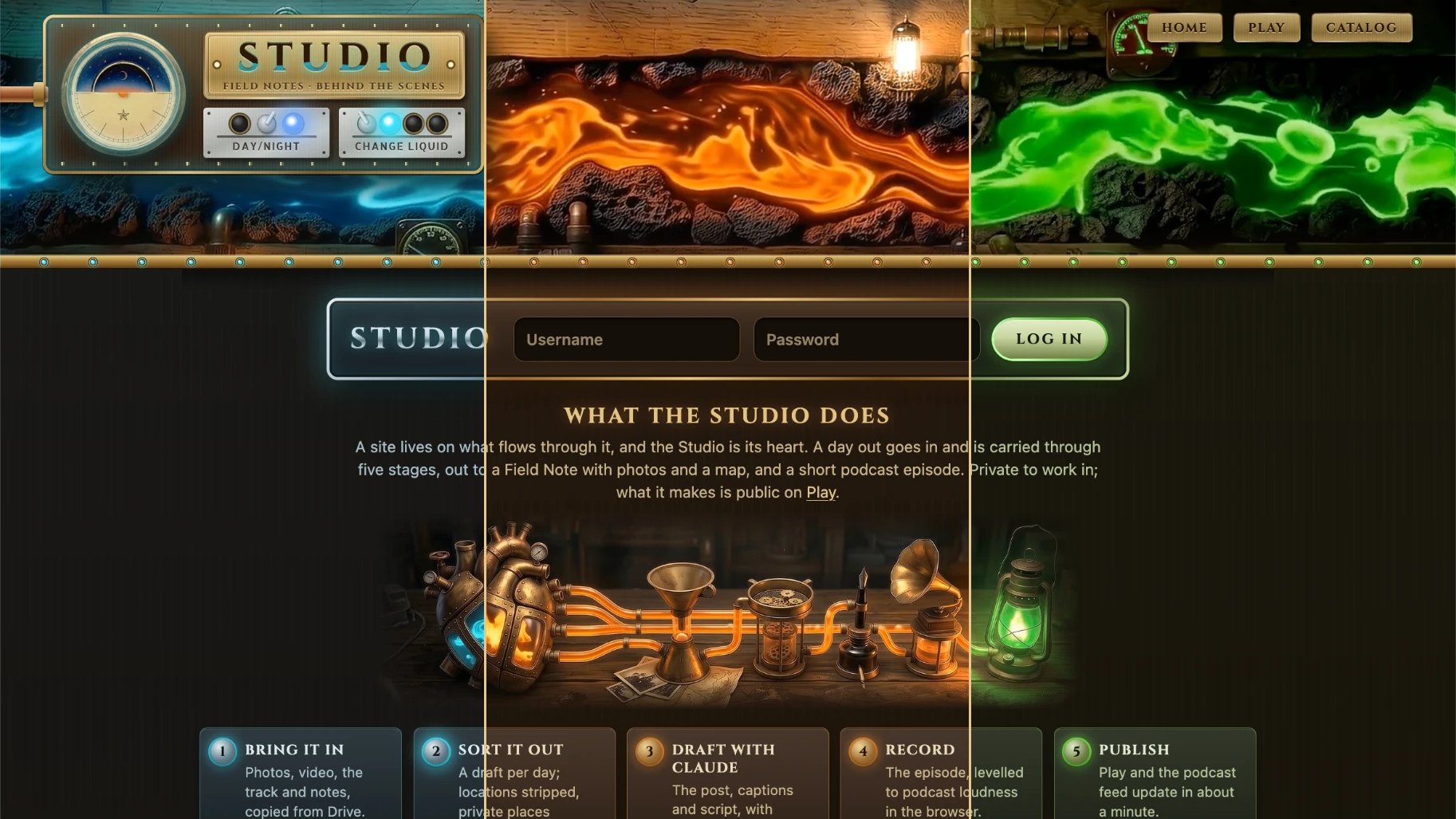
The Studio is the private side of this site, where a day out becomes a Field Note. It deserved a front door that felt like a workshop, so its header became a glowing river running through a crack in an old workbench, with a brass STUDIO panel bolted on above it.
Green, then blue
It began green, from rendered 4K footage. Then I wanted a blue river, and the best I could render was 1080p. That turned out fine: the header is a short, wide strip, so 1920 pixels across is all it ever needs. The first version jumped when you switched. Every change now plays its own clip and crossfades in, and the buttons wait until it's done.
Two small toggles
The controls took the longest. I tried handwheels, then bypass valves with lit windows, then valves down in the footer, then lamps beside them. It was all too much. What stuck is the smallest version: two little toggles on the panel, each between jewel pilot lamps. DAY/NIGHT plays dusk or dawn. CHANGE LIQUID only goes one way round, blue to green to orange and back to blue, so every change has exactly one clip.
That one-way rule is what made it buildable. Three liquids, day and night, each with a loop, a dusk and dawn, and a change to the next liquid: 18 clips for the river and 18 more for the glowing pipe in the footer. With each one in a few sizes for different screens, that's 124 video files behind one header.
That one-way rule is what made it buildable.
How it's built
- Render the river
Green came first, from 4K footage. Blue could only be rendered at 1080p, which is plenty: the header is a short, wide strip, so 1920 pixels across is all it needs. Orange makes the third liquid.
- Give every change its own clip
The first version jumped on a switch. Now each change plays its own clip and crossfades in, and the buttons wait until it's done.
- Cut the controls down
Handwheels, bypass valves with lit windows, valves in the footer and lamps beside them were all tried and cut. What stayed: two little toggles on the panel, each between jewel pilot lamps.
- Run the liquids one way round
CHANGE LIQUID goes blue to green to orange and back to blue, so every change has exactly one clip. With day and night, that's 18 clips for the river and 18 for the footer pipe, 124 files across sizes.
- Put every clip through one light model
The glass tube's glow is measured once from the blue night footage, then painted back in the liquid's colour, scaled by how dark the scene is. Both ends of each change are graded to the loops they meet.
- Let the liquid spread
The rivets in the brass rails fill with its colour, the page skin shifts with it, and the STUDIO letters fill with a slow wave using a CSS text-filling technique, draining and refilling on every change.
- Put the look in the address
A ?look= link opens in the same liquid and time of day it was shared in, and its preview card shows it.
One light model
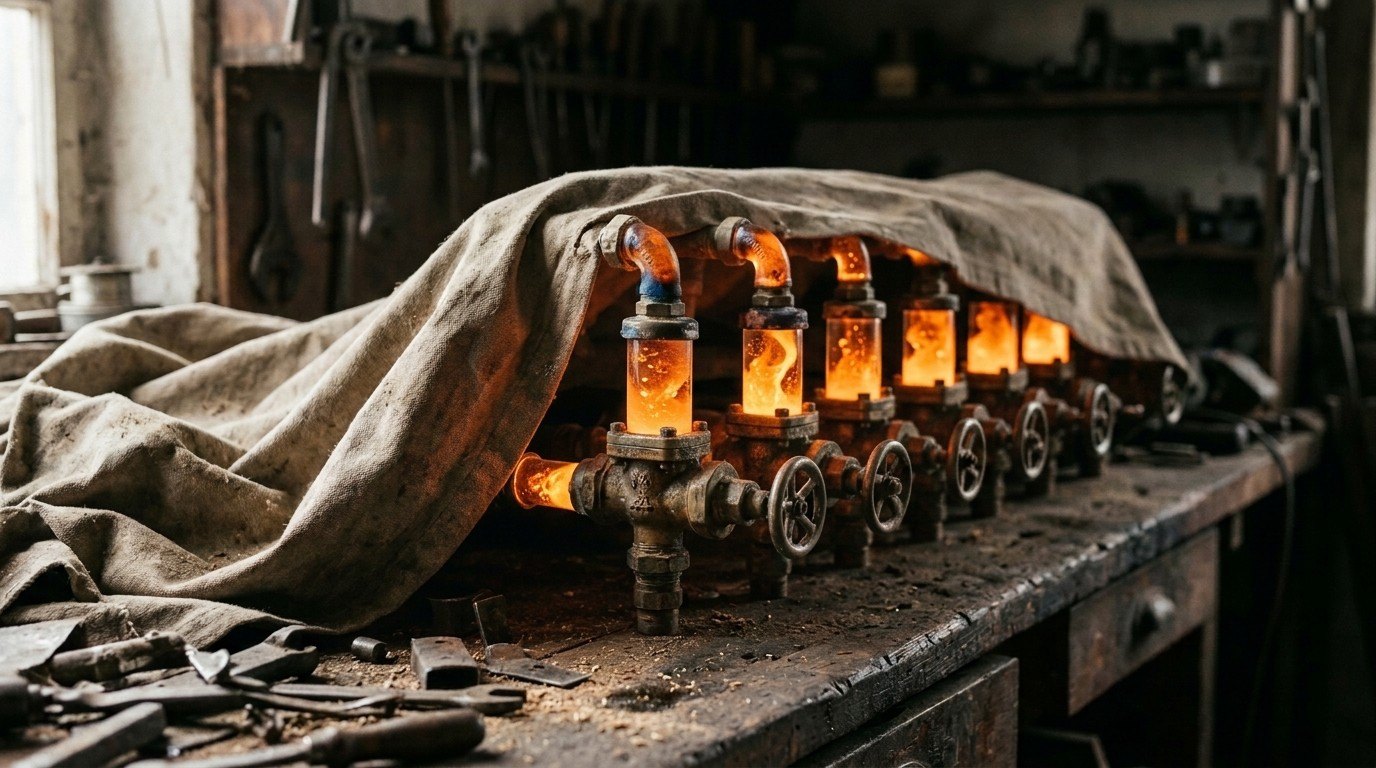
The renders never quite agreed with each other. A glass tube on the river bank was lit in one clip and dark in the next, and a new render would arrive with the lamps glowing green when the loop it hands over to has them orange. So every clip goes through the same light model before it's used. The tube's glow is measured once from the blue night footage, then painted back in the colour of the liquid, scaled by how dark the scene is. Both ends of each change are graded to match the loops they meet, so the hand-offs don't show.
The liquid spreads
Then the liquid started spreading. The rivets in the brass rails fill with its colour. The page itself shifts: gold on walnut for orange, steel on slate for blue, verdigris on bronze for green. The STUDIO letters fill with it too, a slow wave running through them, borrowed from an old CSS trick for text filling with water. On every change they drain and fill again.
Even the links remember. The address carries the look, so a link shared at night with the orange liquid opens that way, and its preview card shows it.
What I learned: less is more, again. The valves were fun to build and wrong to keep. And it only feels like one machine when the light agrees everywhere, so measure the light once and paint it back the same way in every clip.
Build log
A green river, from rendered 4K footage
A blue river, rendered at 1080p; orange joins as the third liquid
The first version jumped on a switch; every change gets its own crossfading clip, and the buttons wait
Handwheels, then bypass valves with lit windows, then valves in the footer, then lamps beside them
Two toggles between jewel pilot lamps, and a one-way change cycle
A tube light model learned from the blue night footage, re-applied to every clip; change ends graded to the loops
Rivets, page skin, liquid-filled STUDIO letters and glowing buttons
Per-look share cards via ?look=