



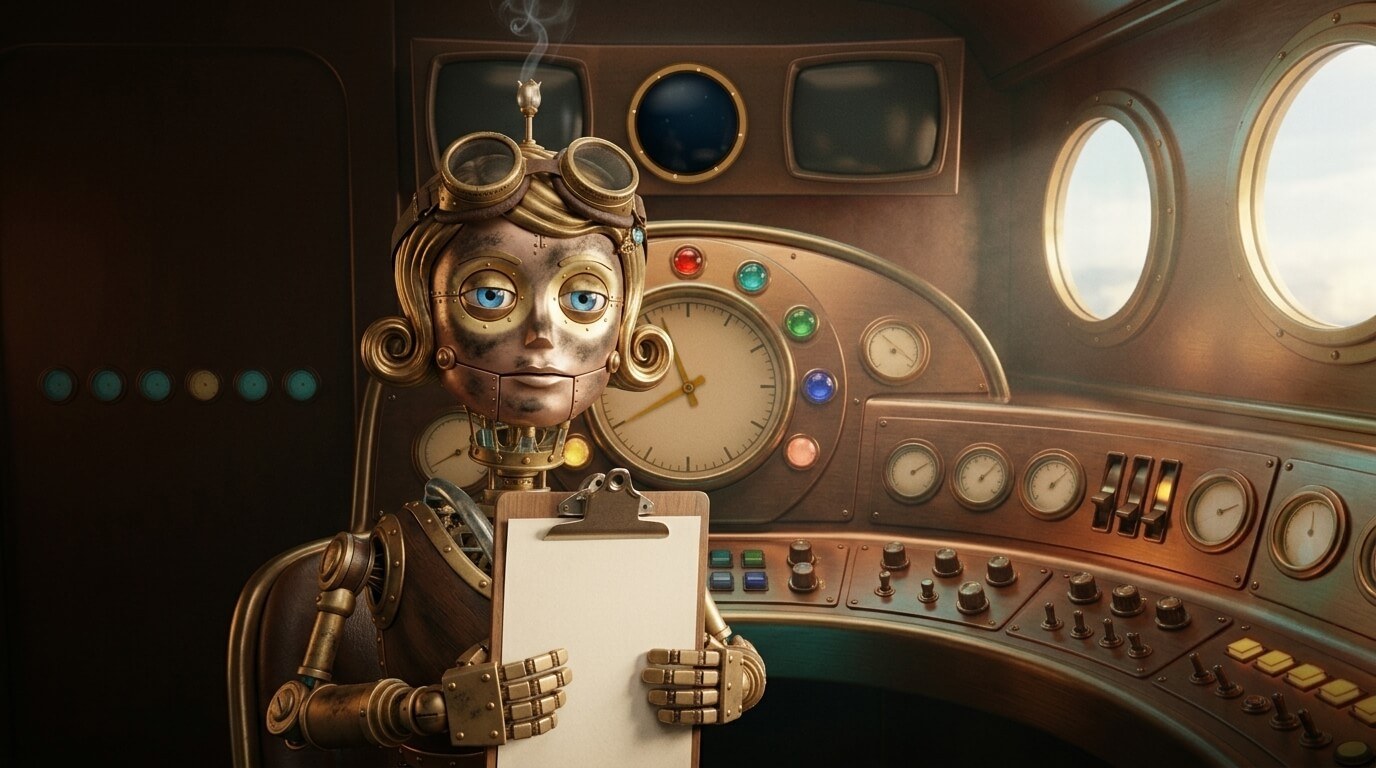
The machine sits at the top of the Web tab on christiangehrke.com, and it does not look like a web page. It looks like the cockpit of something that should not be allowed out of the hangar: a brass console, a row of portholes, a ring of glowing jewels around one enormous dial, and more knobs than any reasonable pilot needs. Its inventor calls it the Tumble. We sent our most reliable test pilot to find out what it does.
A time machine for the browser
Christian Gehrke has been building websites since 1997. As he puts it, saying you built a website in 1997 doesn't mean a lot to a lot of developers now. What does mean something is the tools you had back then: tables, basic CSS, just images and some JavaScript. Then, as time goes on, more tools arrive. The Tumble shows it: a fall from today, at the top, all the way back to the first browser in 1990, at the very bottom.
It's a time machine, but it's focused on the browser: the arch-enemy of a web developer, and also the tool that lets us do our job.
The nemesis
As a developer, he told us, it was always fighting with the browser. You had to do fixes for every version: Netscape, the Mozillas, Firefox, Chrome, whatever it was. And yet there's no web developer whose work doesn't get seen in a browser at some point. That's what you're building for. So there's this struggle between them, and the dashboard puts the browsers right where you can't miss them: nine jewels in a ring around the big dial, one for each browser, from Mosaic to Brave.
Test one: the jewels
Press a jewel and that browser comes up close, under the glass of the big dial, with the year it arrived. Press the year and the whole page tumbles down to that moment in history, slowly. Nothing snaps. It lowers you like a lift with good manners.
Test two: the knobs
The row of knobs on the right looks decorative. It is not. Turn one and a surge runs through the machine: every gauge sweeps up and back and glows orange, the portholes flare white-gold, rings of light pulse out, and a burst of golden bubbles rises past the porthole up top. Our test pilot turned it again. Then a third time, quickly. That was a mistake.
Test three: 88

Three quick turns, or one press of the button that has been breathing at you the whole time, and the big dial reads 88 MPH. The lights on the desk start running like Christmas lights strung along a porch. Then the jump: a crack of light, two trails of fire and a spinning plate, all playing out under the glass of the big dial. Our pilot's notes from this part of the test are unprintable. Her hair, as you can see, did not come through it.
Test four: the porthole
Above the dials sits a porthole into deep water. Every so often a bubble drifts up with a browser inside it. Press a browser and its own bubble is released, with a burp of air behind it to lift it on its way. Press it again, and again, and the porthole fills.
Ejecting little bubbles out into the ether in this little chamber, and watching the bubbles with the logos go up, is a bit therapeutic.
The fall
Scroll, or pull the tape down the right-hand side, and the page falls back through every era he's worked in: what the browsers could do, the tricks developers used when they couldn't, and what he was building at the time. Near the bottom, in 1997, there's a trick from the period you can still pull on yourself.
 1Test pilot (goggles down)2Nine browser jewels3The year dial4Clockwork (artist's licence)5Surge valves6The bubble coil7Portholes, lit from outside
After the jump
There are hidden Easter eggs in there too, he says, that make it kind of fun. We found some. We're not telling you where. A lot of it, he told us, was simply a challenge in design and animation: to see what could be done to make the dashboard actually work. Once he saw the dash panel and how it looked, putting the browsers themselves into it was, in his words, pretty cool. We'd go further.
The verdict
88/ 88 MPH
Tested by Popular Paradox
A history lesson you can fly. The Tumble makes twenty-nine years of web building something you can see and touch, from 1997's tables and spacer images up to today, and it's honest about the browser: the nemesis and the reason for the job at the same time.
Recommended for developers, the curious, and anyone who has ever had to fix the same page for every browser. Goggles advised.